


I think. short term vs long term crypto tax, The days when cryptocurrency transactions could easily go unnoticed by tax authorities are ending. Beginning in 2026, new IRS reporting requirements are giving regulators greater visibility into digital asset transactions. Whether you invest in Bitcoin, Ethereum, Solana, or other cryptocurrencies in different exchanges. Understanding how capital gains taxes work is now an essential part of responsible investing.

Many crypto investors believe tax calculations are complicated, but the reality is much simpler. Once you understand how cost basis, holding periods, taxable events, and capital gains work together, calculating your crypto tax becomes a straightforward process which capigain.top can explain.
This guide explains everything you need to know about calculating crypto capital gain tax in the United States for 2026, using clear examples and practical scenarios that beginners can easily follow.
What Is a Crypto Capital Gain?
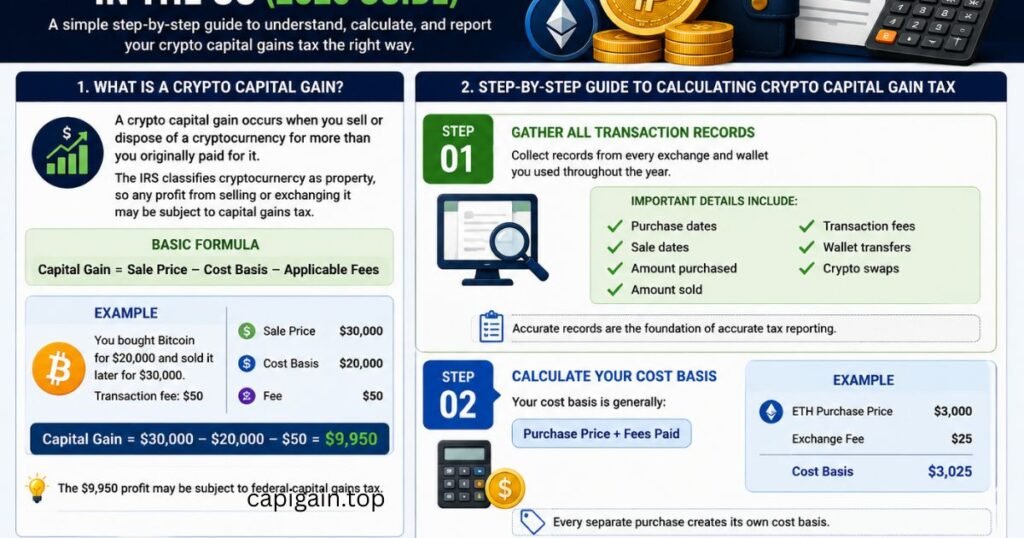
A crypto capital gain occurs when you sell or buy cryptocurrency for more than you originally paid for it.
Because the IRS classifies cryptocurrency as property rather than currency, any profit generated from selling or exchanging crypto may create a taxable event.
Basic Formula
Capital Gain = Sale Price − Cost Basis − Applicable Fees
Example
Suppose you purchased Bitcoin for $75,000.
A year later, you sell it for $95,000 and pay a $50 transaction fee.
Your calculation would look like this:
- Sale Price: $75,000
- Cost Basis: $95,000
- Fee: $50
Capital Gain = $95,000 − $75,000 − $50 = $19,950
The $19,950 profit may be subject to federal capital gains tax.
Step by Step Guide to Calculating Crypto Capital Gain Tax
Step 1: Gather All Transaction Records
Start by collecting records from every exchange and wallet you used throughout the year.
Important details include:
- Purchase dates
- Sale dates
- Amount purchased
- Amount sold
- Transaction fees
- Wallet transfers
- Crypto swaps
Accurate records are the foundation of accurate tax reporting.
Step 2: Calculate Your Cost Basis
Your cost basis is generally:
Purchase Price + Fees Paid
For example:
- ETH Purchase Price: $3,000
- Exchange Fee: $25
Cost Basis:
$3,025
Every separate purchase creates its own cost basis.
Step 3: Determine the Fair Market Value
When you sell, exchange, or spend cryptocurrency, determine its fair market value at the exact time of the transaction.
This value becomes your sale proceeds.
Step 4: Identify the Holding Period
The amount of time you held the asset determines which tax rate applies.
- Less than one year = Short-Term Capital Gain
- More than one year = Long-Term Capital Gain
This distinction can significantly affect your tax bill.
Step 5: Net Gains and Losses
Combine all gains and losses from the year.
Example:
- Total Gains: $15,000
- Total Losses: $5,000
Net Capital Gain:
$10,000
Taxes are generally calculated on the net amount.
Short-Term vs Long-Term Capital Gains
Short-Term Capital Gains
If you hold cryptocurrency for one year or less before selling, profits are taxed as ordinary income.
This means the gain is added to your other taxable income and taxed according to your income bracket.
Long-Term Capital Gains
If you hold cryptocurrency for more than one year, lower long-term capital gains rates may apply.
Because long-term rates are often significantly lower, many investors intentionally hold assets beyond the one-year mark before selling.
Common Crypto Transactions That Trigger Taxes
Many investors incorrectly assume taxes only apply when converting crypto into dollars.
In reality, several activities can create taxable events.
Taxable Events
- Selling cryptocurrency for cash
- Trading one cryptocurrency for another
- Spending crypto on goods or services
- Receiving crypto as compensation
- Certain staking rewards
- Some airdrops
Non-Taxable Events
- Buying cryptocurrency with USD
- Holding cryptocurrency without selling
- Moving crypto between wallets you personally own
Understanding this difference helps prevent reporting mistakes.
Why Crypto-to-Crypto Trades Matter
One of the most misunderstood tax rules involves crypto swaps.
Example
You purchase Ethereum for $2,000.
Months later, Ethereum rises to $3,500.
You exchange Ethereum for Solana.
Although no dollars were involved, the IRS generally treats the transaction as if you sold Ethereum at $3,500.
Your taxable gain would be:
$3,500 − $2,000 = $1,500
Your new Solana position then begins with a cost basis of $3,500.
This rule applies across many centralized and decentralized platforms.
New IRS Reporting Changes in 2026
Tax reporting requirements continue to evolve as cryptocurrency becomes more mainstream.
Beginning in 2026, additional reporting mechanisms are expected to improve transparency between cryptocurrency platforms and the IRS.
For investors, this means accurate record-keeping is more important than ever.
Keep copies of:
- Trade confirmations
- Exchange statements
- Wallet histories
- Transaction exports
- Tax reports
Maintaining organized records can save significant time and stress during tax season.
How Crypto Losses Can Reduce Taxes
Losses are not always bad news.
The IRS generally allows capital losses to offset capital gains.
Example
You earned:
- Bitcoin Gain: $12,000
But lost:
- Solana Loss: $4,000
- Altcoin Loss: $2,000
Net Gain:
$12,000 − $6,000 = $6,000
Instead of paying taxes on $12,000, you only pay taxes on $6,000.
This strategy can substantially reduce overall tax liability.
Understanding Multiple Purchases
Many investors buy the same cryptocurrency multiple times at different prices.
Example:
- Purchase 1 ETH at $1,800
- Purchase 1 ETH at $2,400
- Purchase 1 ETH at $3,000
Later, you sell 1 ETH.
The question becomes:
Which ETH was sold?
Several accounting methods may be available.
FIFO (First In, First Out)
Oldest coins are sold first if they in profit;
LIFO (Last In, First Out)
Newest coins are sold first when in profit
Specific Identification
You select the exact coins being sold for capital gain.
HIFO (Highest In, First Out)
Highest-cost coins are sold first if in profit.
Different methods can produce dramatically different taxable gains.
Four Common Crypto Tax Mistakes
1. Ignoring Crypto Swaps
Many investors forget that exchanging one cryptocurrency for another may create a taxable event.
2. Excluding Transaction Fees
Fees can reduce taxable gains.
Failing to include them may result in overpaying taxes.
3. Selling Before Long-Term Status
Selling shortly before reaching one year can trigger higher short-term tax rates.
4. Poor Record Keeping
Missing wallet histories and transaction records can create reporting problems later.
Good documentation is one of the simplest ways to avoid tax complications.
Should You Use Crypto Tax Software?
For investors with numerous transactions, specialized tax software can simplify reporting.
Benefits include:
1.Automatic transaction imports
2. Gain and loss calculations
3.Cost basis tracking
4.Tax report generation
5.Exchange integration
Popular crypto tax platforms can save considerable time and reduce errors for active traders.
Frequently Asked Questions
Do I Have To Report Small Crypto Gains?
Yes. Even small gains may be reportable under IRS rules.
Is Holding Crypto Taxable?
No. Simply holding cryptocurrency generally does not create a taxable event.
Are Wallet Transfers Taxable?
No. Transfers between wallets you own are generally not taxable.
Can Crypto Losses Reduce Taxes?
Yes. Capital losses can often offset capital gains and potentially reduce taxable income.
Is Bitcoin Taxed Differently Than Other Cryptocurrencies?
No. Bitcoin generally follows the same capital gains rules that apply to most cryptocurrencies.
Final Thoughts
Learning how to calculate crypto capital gain tax in the US for 2026 is one of the most valuable skills a cryptocurrency investor can be develop. The process becomes much easier when you focus on 4 key elements: cost basis, fair market value, holding period, and net gains or losses in trading.
Keeping detailed transaction records, understanding taxable events, and using the right accounting method can help you calculate your taxes accurately and avoid costly mistakes. As cryptocurrency regulations continue to evolve, maintaining organized records and staying informed will make tax season far less stressful.
For most investors, the goal is simple: track every transaction, calculate gains correctly, and report them accurately. Doing so helps ensure compliance while allowing you to make smarter long-term investment decisions.

Muhammad Qaisar is the founder and lead researcher at Capigain.top, a financial education platform dedicated to helping everyday people understand capital gains across cryptocurrency, real estate, gold, and agricultural investments. With a passion for making complex financial topics simple and accessible, Muhammad writes in-depth, research-backed guides that help readers make smarter investment decisions. He believes that financial knowledge should be available to everyone, not just experts.