Gold ETF vs Physical Gold: Which One Gives Better Capital Gain for Small Investors in 2026?

May 21, 2026
Written By Muhammad Qaisar

Lorem ipsum dolor sit amet consectetur pulvinar ligula augue quis venenatis. 

🥇
Live Gold Spot Price
Updates every 60 seconds · Source: metals-api
USD / oz
Loading…
Change (24h)
EUR / oz
GBP / oz
Fetching price…

Here is something that genuinely surprises most first-time gold investors: a Gold ETF and a physical gold bar can track the exact same price movement — yet at tax time, one of them can quietly cost you hundreds of dollars more than the other. The gap is not in how gold performs. It lives in what you actually own, what it costs to hold it, and a tax rule that most investors only discover after the damage is done.

Gold has had one of the most extraordinary runs in modern investment history heading into 2026. Spot prices crossed $4,900 per ounce earlier this year — driven by central bank accumulation, falling real interest rates, and geopolitical uncertainty that has pushed investors toward safe-haven assets with renewed urgency. For many small investors, it has been the single best-performing asset in their portfolio over the past three years.

Which naturally brings up the question everyone is asking: should I be holding a Gold ETF, or should I own the physical metal itself? This guide gives you an honest, numbers-backed answer for 2026 — not a vague “it depends” that leaves you exactly where you started.

1. What Is a Gold ETF — and What Do You Actually Own?

A Gold ETF (Exchange-Traded Fund) is a financial product listed on a stock exchange. When you buy shares of a Gold ETF, you are purchasing a stake in a fund that holds physical gold in a secured, insured vault on your behalf. You do not personally receive or store any gold. What lands in your brokerage account is a share of the fund — not a bar of metal.

The four most widely held Gold ETFs in 2026, with their key stats:

ETF Name Ticker Annual Fee AUM (May 2026)
SPDR Gold Trust GLD 0.40% $154+ billion
iShares Gold Trust IAU 0.25% $83+ billion
SPDR Gold MiniShares GLDM 0.10% $25+ billion
iShares Gold Trust Micro IAUM 0.09% ~$6 billion

The practical appeal for small investors is hard to argue with: open any brokerage account, buy shares with as little as $10 using fractional shares, and you have immediate, real-time exposure to the gold price. No vault to arrange. No shipping insurance. No purity certification required. It is, by every measure of convenience, the simplest way to get into gold.

But convenience has a hidden cost — and it shows up at tax time in a way that catches most investors completely off-guard. We will get there in Section 5.

2. What Is Physical Gold Investing?

Physical gold investing means you personally own a tangible asset — a coin, bar, or round — that exists independently of any financial institution, fund manager, or brokerage platform. The most common forms bought by small investors are government-minted bullion coins: the American Gold Eagle, the Canadian Maple Leaf, and the South African Krugerrand.

The key thing to understand before you buy is that the price you pay is never the spot price you see quoted on financial websites. It always includes a dealer premium — a markup that covers manufacturing, distribution, and the dealer’s operating margin.

💡 Typical Dealer Premiums Over Spot Price (2026):

  • 1 oz government bullion coins (Eagle, Maple Leaf): 5% – 8% above spot
  • 1 kg gold bars: approximately 2% above spot
  • Small bars (1g – 10g): 10% – 20% above spot — avoid these for capital gain purposes
  • Gold ETF share purchase: essentially spot price — zero dealer premium

That upfront premium functions as a hidden breakeven hurdle. Before you have earned a single dollar of capital gain on physical gold, the spot price must first rise enough to cover the premium you paid when you bought. On a $3,000 purchase with a 6% premium, that means gold must increase by $180 just to get you back to zero — before any real profit begins.

3. Capital Gain Comparison: Real Numbers, 2020–2026

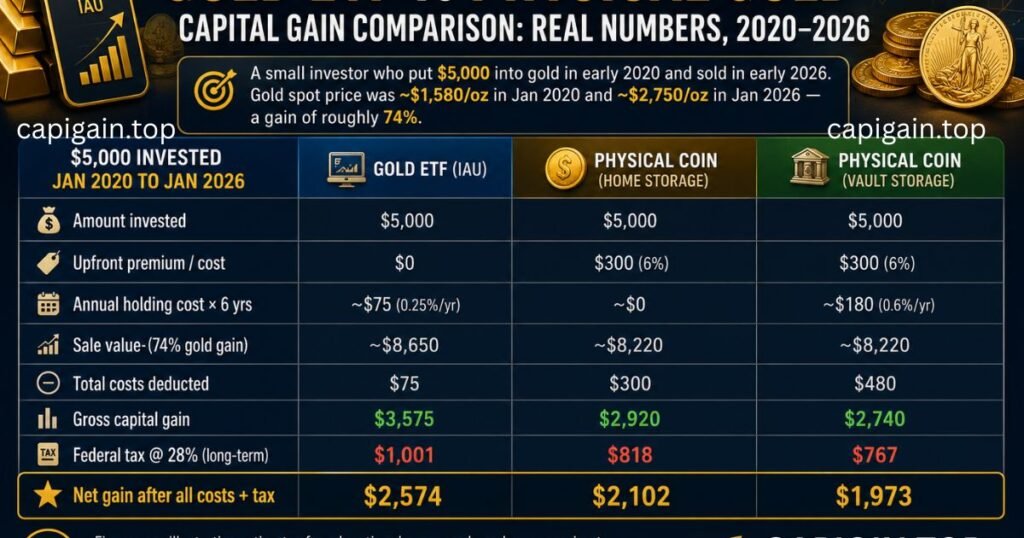
Let us look at a realistic scenario: a small investor who put $5,000 into gold in early 2020 and sold in early 2026. Gold spot price was approximately $1,580/oz in January 2020 and approximately $2,750/oz in January 2026 — a gain of roughly 74%.

📊 $5,000 Invested — January 2020 to January 2026

Cost / Return Item Gold ETF (IAU) Physical Coin (home storage) Physical Coin (vault storage)
Amount invested $5,000 $5,000 $5,000
Upfront premium / cost $0 $300 (6%) $300 (6%)
Annual holding cost × 6 yrs ~$75 (0.25%/yr) ~$0 ~$180 (0.6%/yr)
Sale value (74% gold gain) ~$8,650 ~$8,220 ~$8,220
Total costs deducted $75 $300 $480
Gross capital gain $3,575 $2,920 $2,740
Federal tax @ 28% (long-term) $1,001 $818 $767
Net gain after all costs + tax $2,574 $2,102 $1,973

Figures are illustrative estimates for educational purposes based on approximate gold price movements. Actual results will vary by dealer, tax bracket, and timing. See full disclaimer below.

On this particular scenario, the Gold ETF produced roughly $472 more in net after-tax capital gain than physical gold with home storage — on a $5,000 investment held for six years. Not a fortune, but meaningful on a percentage basis. The vault-storage scenario widens the gap further.

The takeaway is not that ETFs always win. It is that costs and tax treatment matter far more than most investors expect — and the difference compounds over time.

4. The True Cost of Each Option — What Nobody Tells You Upfront

Most comparisons stop at “ETFs charge an expense ratio, physical gold has storage fees.” That surface-level view misses several costs that significantly affect your real capital gain.

Gold ETF — Full Cost Picture

  • Annual expense ratio: The cheapest options (IAUM, GLDM) charge 0.09%–0.10%. The largest and most popular (GLD) charges 0.40%. On $10,000, that is $9–$40 per year — a modest drag, but one that compounds over time.
  • Trading commissions: Fidelity, Schwab, and Robinhood all offer zero-commission ETF trades. This cost is effectively eliminated for most small investors in 2026.
  • Bid-ask spread: On high-volume ETFs like GLD and IAU, this is negligible — typically just a few cents per share.
  • No exit premium: When you sell ETF shares, you transact at the market price. There is no dealer margin eating into your proceeds the way there is with physical gold.

Physical Gold — Full Cost Picture

  • Dealer premium at purchase: 2%–8% on coins, higher on small bars. This is a one-time cost — but it must be fully recovered before any capital gain begins.
  • Home storage: A quality fireproof safe runs $200–$600. Standard homeowner’s insurance typically does not cover gold bullion against theft unless you add a scheduled rider — an often-overlooked cost.
  • Professional vault storage: 0.5%–1% per year. At $10,000 of gold, that is $50–$100 annually.
  • Dealer spread at sale: When you sell to a dealer, you receive a few percent below the spot price. This friction cost does not exist with ETF sales.
  • Insurance: If you store at home without a bullion-specific insurance rider, a theft or fire could leave you with nothing. Adding coverage costs 0.5%–1% annually.

✅ The Honest Cost Summary:

For investments under $10,000 with professional vault storage, Gold ETFs are typically lower total cost. For investors who store securely at home and hold for a decade or longer, physical gold’s one-time premium becomes a smaller and smaller percentage of a growing investment — and there are no annual fees quietly reducing your position year after year.

5. Tax Treatment: Where the Real Difference Actually Lives

This is the section that reframes the entire comparison — and the one most articles either skip or bury at the bottom.

The widely held assumption is that because a Gold ETF trades like a stock, it must be taxed like a stock. That assumption is wrong, and it is an expensive mistake.

The IRS classifies both physical gold and physically-backed Gold ETFs — including GLD, IAU, GLDM, and IAUM — as collectibles. The collectibles capital gain rate is a maximum of 28% for long-term holdings. This is 8 percentage points higher than the 20% maximum that applies to stocks and standard equity ETFs.

Investment Type Short-Term (<1 yr) Long-Term (>1 yr)
Physical Gold (bars, coins, jewelry) Up to 37% Max 28% ⚠️
Physical Gold ETFs (GLD, IAU, GLDM, IAUM) Up to 37% Max 28% ⚠️
Standard Stock or Equity ETF (S&P 500, etc.) Up to 37% 0%, 15%, or 20% ✅
Gold Mining Stock ETFs (GDX, GDXJ) Up to 37% 0%, 15%, or 20% ✅

⚠️ The Surprise That Hits Investors at Tax Time:

Many gold ETF investors receive their 1099 tax form and discover their long-term gain is taxed at 28% rather than the 15% or 20% they expected from holding what felt like a “stock.” On a $10,000 capital gain, that is $800–$1,300 in additional federal tax. Emily Doak, director of ETF and index fund research at the Schwab Center for Financial Research, has confirmed: “The IRS treats such ETFs the same as an investment in the metal itself.” This applies to GLD, IAU, SGOL, GLDM, and IAUM without exception.

The Single Best Way Around This Problem:

Hold your Gold ETF shares inside a Roth IRA. Capital gains inside a Roth IRA grow completely tax-free. The 28% collectibles rate becomes completely irrelevant. Most investors do not do this — and it is one of the most straightforward, high-impact moves available to any gold investor in 2026.

6. Best Choice Based on Your Budget — Quick Decision Guide

Your Situation Recommended Choice Key Reason
Budget under $1,000 Gold ETF No premium barrier; any dollar amount; instant liquidity
Budget $1,000–$5,000 Either — or split 50/50 1–2 oz coins are practical; ETF equally competitive here
Budget over $5,000, holding 5+ years Physical Gold No annual fees; premium becomes small % over long hold
Want to trade actively or adjust frequently Gold ETF Sell in seconds; no dealer friction on exit
Want zero counterparty risk Physical Gold You own the asset directly; no fund, no custodian dependency
Investing inside a Roth IRA Gold ETF (strongest move) All gains grow tax-free — the 28% collectibles problem disappears

7. Four Misconceptions That Cost Investors Real Money

Researching this comparison deeply revealed a consistent set of mistakes that investors make — not because they are careless, but because these specific misconceptions are genuinely widespread and almost never corrected in mainstream financial coverage.

❌ Misconception #1: “Gold ETFs are taxed like regular stocks”

This is the most expensive myth in gold investing. Physical gold ETFs — GLD, IAU, GLDM, IAUM — are taxed as collectibles at a maximum 28% long-term rate, not 15% or 20%. The IRS makes no distinction between holding the physical metal yourself and holding a fund that holds it for you. Most investors discover this only when their tax form arrives.

, Misconception #2: “Physical gold outperforms because it’s real and tangible”

Emotional ownership is not a return driver. Both physical gold and a Gold ETF track the same underlying spot price. The difference in capital gain over a 5-year period comes entirely from costs (premiums, storage, fees) and taxes — not from whether or not the metal is sitting in your safe.

. Misconception #3: “Storing gold at home costs nothing”

A quality fireproof, bolt-down safe costs $200–$600 upfront. More importantly, a standard homeowner’s or renter’s insurance policy typically does not cover bullion theft — you need a scheduled personal property rider, which adds 0.5%–1% annually. Factor these in before assuming home storage is free.

. Misconception #4: “Small gold coins and bars are a good capital gain vehicle”

Fractional gold coins (1g, 2g, 5g) carry premiums of 10%–20% above spot. On a $300 purchase, that is $30–$60 that gold must first gain in value before you see a single dollar of profit. At that premium level, the math rarely works in your favor. If you are investing small amounts, a Gold ETF is almost always the more efficient choice.

8. Frequently Asked Questions

Can I invest in a Gold ETF with less than $100?

Yes. ETFs like IAUM and GLDM are available as fractional shares through Fidelity, Schwab, and Robinhood, meaning you can start with any dollar amount. This is one of the clearest practical advantages of ETFs for investors who are just getting started.

What happens to a Gold ETF if the fund company goes bankrupt?

Reputable Gold ETFs are structured as trusts, and the gold they hold is legally segregated from the fund issuer’s balance sheet. In a bankruptcy scenario, that gold would be distributed to shareholders through the Authorized Participant mechanism. Unlike a bank deposit, the custodian cannot use your gold to settle its own liabilities — though the custodian itself carries its own counterparty risk worth understanding.

Are gold mining ETFs taxed the same way as physical gold ETFs?

No — and this distinction matters. ETFs that hold shares in gold mining companies (such as GDX or GDXJ) are classified as equity investments. Their long-term capital gains are taxed at the standard 0%, 15%, or 20% rate — not the 28% collectibles rate. For tax-aware investors, gold mining ETFs offer better after-tax efficiency than physical gold ETFs, while still providing significant exposure to gold price movements.

What percentage of my savings should I allocate to gold?

David Rosenstrock, CFP and Director of Financial Planning at Wharton Wealth Planning in New York, recommends keeping gold exposure to no more than 5%–10% of a total investment portfolio. His view is consistent with most certified financial planners: gold is most effective as an inflation hedge and crisis buffer — not as a primary growth engine. Over long periods, stocks and bonds have historically provided significantly stronger returns than gold as a core asset class.

Which is better for long-term wealth preservation — ETF or physical?

For multigenerational wealth preservation where counterparty risk is the primary concern, physical gold has the stronger theoretical case — it exists independently of any financial institution or platform. For a small investor focused on capital gain within a 3–10 year window using a tax-advantaged account, a low-cost Gold ETF held inside a Roth IRA is typically the more practical and tax-efficient approach.

The Verdict: Which One Is Right for Small Investors in 2026?

After working through the numbers honestly, the answer comes down to three things: your budget, your time horizon, and which account type you are using.

Under $1,000 to invest? A Gold ETF is the clear choice. Zero upfront premium, fractional share availability, and instant liquidity make it by far the most practical entry point.

Investing $3,000 or more for a 5+ year hold? Physical gold coins become a genuinely competitive option. The one-time premium shrinks as a percentage of a growing position, and eliminating annual management fees is a real long-term advantage.

The single highest impact move available to any gold investor right now is holding a Gold ETF inside a Roth IRA. You eliminate the 28% collectibles tax problem entirely, let every dollar of capital gain compound tax-free, and maintain full liquidity. It takes fifteen minutes to set up and most investors simply never do it.

Want to keep building your gold investment knowledge? These guides cover the next steps:

A Note From Muhammad Qaisar, Capigain.top

When I first sat down to write this comparison, I genuinely expected the ETF to win on every metric. It is cheaper to start, simpler to manage, and trades in seconds. What I did not fully appreciate until I dug into the tax code was just how much the 28% collectibles rate erodes the apparent advantage — and how completely that problem evaporates the moment you move the ETF into a Roth IRA. That one structural insight changed the entire framing of the comparison for me, and it is the reason I wanted to lead with the tax section rather than bury it. If any part of this guide raised questions specific to your situation, please reach out through the Contact page — I read every message personally.

⚠️ Important Disclaimer

This article is provided for informational and educational purposes only and should not be considered financial, investment, legal, or tax advice. Any investment examples, calculations, or figures mentioned are illustrative estimates based on approximate historical and publicly available data and should not be interpreted as guarantees or predictions of future performance. Gold prices can be highly volatile and may increase or decrease over time. Tax treatment discussed in this article reflects a general understanding of U.S. federal regulations as of 2026 and may vary depending on individual circumstances, state laws, and future legislative changes. Tax regulations in other countries may differ significantly. Before making any investment, tax, or financial decision, consult a qualified and licensed financial advisor, tax professional, or legal expert to obtain guidance tailored to your specific situation.

Leave a Comment